
Alumni Story | Yu-Yu Cheng: An Art History Journey From Taipei To Princeton
From Taipei to Ann Arbor and now Princeton, Yu-Yu Cheng (MIRS Chinese Studies ’25) has pursued her interest in East Asian art history through the study of visual and material culture. During her time at the University of Michigan, she received two full fellowships, and completed her M.A. thesis on images of the "Queen Mother of the West" (西王母献寿) in paintings and embroidery. She is now pursuing her Ph.D. in the Department of Art and Archaeology at Princeton University.
In this alumni interview, Yu-Yu reflects on her academic journey at the University of Michigan, and her Ph.D. application experience. The interview was conducted in Mandarin Chinese and you can scroll down for Chinese version!
Why did you choose LRCCS for your master’s studies?
Honestly, LRCCS was the first offer I received, and it came with full funding! I barely considered anything after that. I think LRCCS is very supportive of students in all ways.
Which courses most influenced your research at U-M?
In my first semester I took a course called “Buddhist Magic” at the Department of Asian Languages and Cultures. It was also the first course I took in the United States. That professor had a decisive influence on my research. Later I had the chance to co-write a paper with him. It was about a piece of porcelain in the collection of the University of Michigan Museum of Art, commissioned from Jingdezhen by a Thai patron.
Later, I took several courses with my academic advisor for the art history department. I went to college in Nanjing, and it took me a while to learn how to interact with professors in American universities. I actively reached out to her, and she gave me valuable advice. I took two graduate seminars with her, one of which was the theory and methods seminar required of first-year Ph.D. students in history of art. That course had no direct connection to Chinese art, but I learned a lot of art historical theory from it. I studied archaeology during my undergraduate years in China, so I wasn't very familiar with Western theory of art history. Looking back, those two seminars helped me lay a good theoretical foundation, which would have been a rare opportunity in other North American master programs, or in China.
That is one of the things I like about the MIRS program. There are some required courses, of course, but as long as you can justify how a course relates to your research, you can basically take any class you want. You don't spend a lot of time figuring out how to fit in the program's requirements, but can explore what you actually want to learn.
How did your advisor support your studies and research?
I actually mentioned my advisor in my MIRS application materials, but we formally met in my first semester, through the center’s email introduction. I felt very touched, because it gave me the sense that LRCCS cares for each individual student.
From the second semester on, I took a course with my advisor every term. By the start of my second year we were meeting almost every two weeks: first to discuss the progress of my master's thesis, then my Ph.D. applications. I would show her what I had written, and she always had valuable comments.
How did the center support your Ph.D. applications besides funding and mentorship?
I used my undergraduate thesis for my writing sample, but I had to translate it into English and, more than that, try to fit it in the academic dialogue in the U.S. My advisor gave me a lot of good advice through that process.
A professor working on South Asian art also helped me a great deal with revising my statement of purpose. If the program required me to only take courses on East Asian art, I could not have taken the South Asian art courses, and I would never have met the professor.
Could you tell us about your master's thesis?
My thesis sits at the intersection of cultural history and visual material culture. I have always been drawn to marginalized objects. My undergraduate writing sample was about a forgery, and the thesis continues in that vein, though it isn't about forgeries. Taking the story of the Queen Mother of the West as my theme, I assembled 10 works, three of them paintings and seven of them textiles, all on the subject of the Queen Mother of the West offering longevity. None of them are created by famous-hands, but are more like folk art.
I asked three questions. First, what do these works actually depict? Second, whom were they made for, who consumed them? Third, who made them?
For the first question, I did an iconographic study, identifying every figure in the image. There is the Queen Mother of the West, the Eight Immortals, and other figures drawn from folk stories. I connected those figures back to the scripts of traditional opera.
Of the 10 works, one is signed and one carries a colophon that reads rather like a birthday card. Starting from those names, I searched the county gazetteers - which year of tribute-students (gongsheng) are they, and what are their official posts? From there I was able to sketch out who collectors and recipients were: for the most part, low-ranking government officials. That answers the second question.
As for who made them, many previous studies link textiles directly to female labor, but I didn't find solid evidence for that. My hypothesis is, they are more likely to have come from commercial workshops in the Ming and Qing Jiangnan region, and that most of the laborers in those workshops were probably still men.
How did you start this research?
In the summer between my first and second year of master’s studies, I interned at the National Palace Museum in Taipei. At the Palace Museum I have access to their internal database, where I can see everything in the collection. I went through it page by page, from beginning to end. After seeing so many works, I noticed a pattern. I didn't pick out those 10 works right then. What I realized was that "the Queen Mother of the West offering longevity" constitutes a category. The compositions and subject matter form a type. Many of these works are unsigned, or have hardly ever been exhibited.
How does your current Ph.D. research connect to or extend your master's thesis?
I'm drawn to material related to pictorial narrative and its relationship to drama. I am also curious about transmedia presentation: how a single narrative is expressed across different media. I've learned a lot of new things in my Ph.D. program and I'll keep exploring, so there's no settled answer yet. But this is clearly where my research interests began.
What is life in Ann Arbor like?
Living in Ann Arbor is great! I lived in Munger, which is a school dormitory, so the location is good. Munger has six-person suites, so I made some good friends there, and it also broadened my understanding of American culture. There are football games on the weekends, and there is always something else going on.
What advice would you give to students thinking of coming to Ann Arbor?
I think this program suits people who are self-driven. If you have a clear goal, and you come here to see it through, you'll have a sense of direction. And if you receive good funding at U-M, I think that's a rare opportunity.
For students coming from China, or Asia, my advice is to be more active and participate in different activities. If there is someone you want to reach out to, being proactive is the best approach. If you get turned down, so be it. Social events, academic events, all of it is worth going to.
I arrived with my mind fixed entirely on my Ph.D. application, and precisely because of that mindset I think I missed some chances to make friends and to experience Ann Arbor. So if I were to give one piece of advice: do what you have to do, but also set aside one day a week to walk around downtown and go to a few events. I think that makes for a more organic environment for both your life and your academic career. Don't let your whole mind be occupied by applications. I can't claim that getting in a Ph.D. program means that anyone could replicate my path. Much of it is opportunity, and much of it is luck. So don't stake your entire life on it.
It also helps to chat with professors at LRCCS. I felt a bit lost in application season, and in every professor's office hours I would ask them: why did you do a Ph.D.? How did you end up here? I found that many people's paths were quite winding, and knowing that is useful in itself. Meeting people, reaching out, hearing about others' experiences, making friends, all of it is worthwhile.
校友故事|鄭又瑜:从台北到普林斯顿,她的艺术史研究之旅
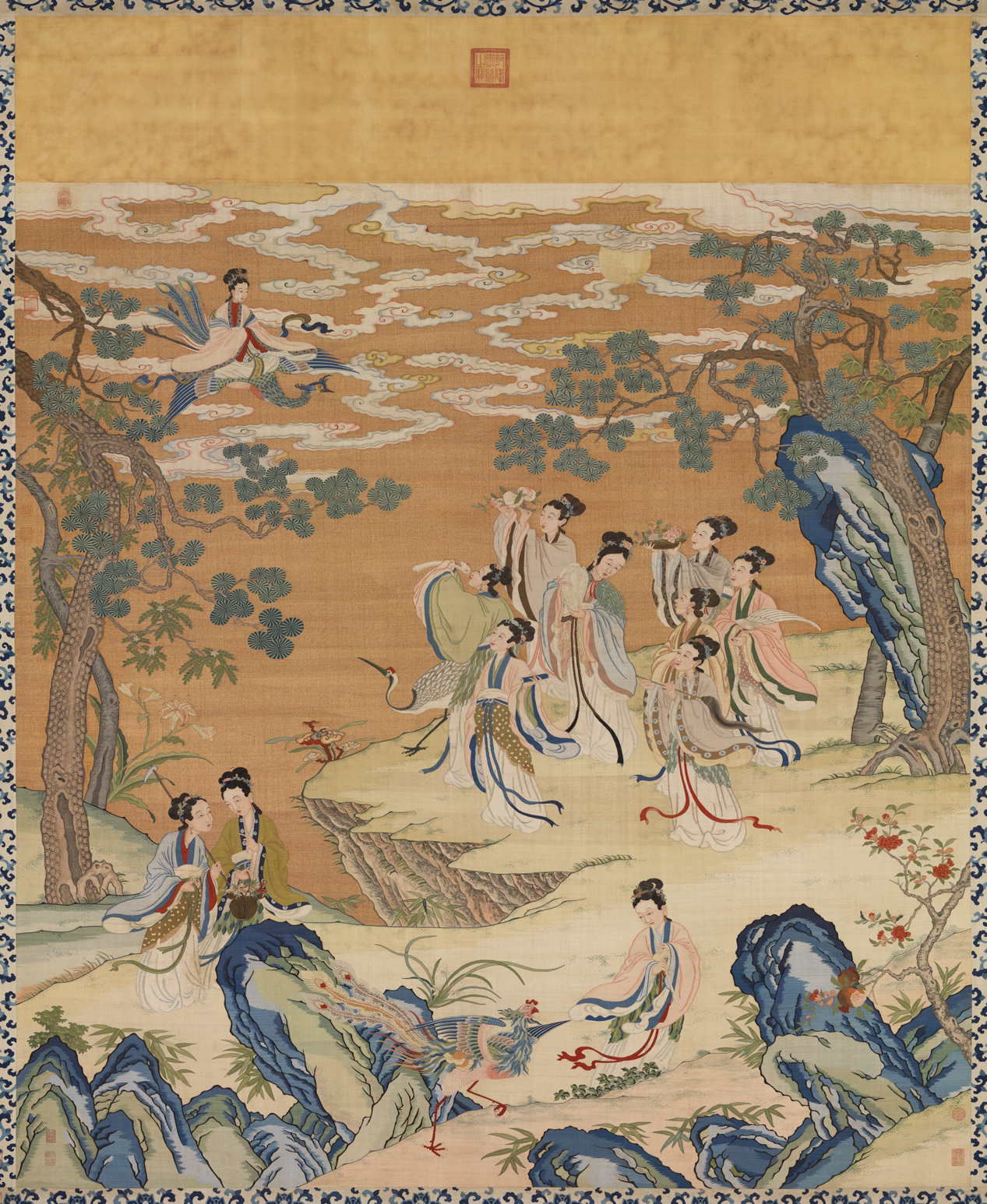
佚名,《群仙祝寿图》,清代(1644—1911年)。缂丝挂轴,204.2 × 194.5厘米。台北故宫博物院藏。
从台北到安娜堡,再到普林斯顿,密歇根大学中国研究硕士校友鄭又瑜(2025届)围绕视觉与物质文化展开她的东亚艺术史研究。在密歇根大学学习期间,她获得 Peking American School Fellowship in Traditional Chinese Studies 和 H. David He and Y. Isabelle Sun Fellowship 两项全额奖学金,并以绘画与丝织品中的“西王母献寿”图像为主题完成硕士论文。如今,她正在普林斯顿大学艺术与考古系攻读博士学位。
在本期校友专访中,又瑜分享了在密歇根大学获得的学术指导与研究机会,以及她的博士申请经验。
你当初为什么选择来 LRCCS 读硕士?
最现实的理由是它给全奖,而且 LRCCS 是第一个发 offer 的。我几乎没有再考虑别的选择,就决定要过来。我觉得密大中国中心在各个方面都非常支持学生。
在密大就读期间,你最有收获、最喜欢的是哪几门课?
我第一个学期上了一门叫 Buddhist Magic 的课,老师来自亚洲语言与文化系,那也是我在美国上的第一门课。这位老师对我整个研究都产生了决定性的影响。后来我有机会和他合写了一篇大约十页的论文,两人联名发表,写的是密大艺术博物馆藏的一件瓷器,是泰国方面委托中国景德镇烧制的。
在一年级下学期和二年级,我跟在艺术史系的导师上了很多课。我之前在南京上大学,本科阶段跟老师的接触往来不会太多,所以我算是慢慢跟她找到了一个相处的平衡点。我很主动地去找她,她给了我很多很有价值的意见。我跟她一共上了两门研究生课,其中一门是艺术史系博士一年级必修的理论与方法研讨课。那门课其实跟中国艺术没有直接关系,但我从中学了很多美术史的理论。因为我本科是学考古的,然后又在国内,所以我其实对于西方美术史的理论并不是很熟悉。现在回头看,这两门课给我打下的理论基础,可能在北美其他项目、或者在大陆都比较少有机会接触到。
我觉得这也是 MIRS 这个项目比较好的地方。当然有一些必修课,但只要你能说明跟你的研究相关,你基本上可以选任何你想选的课,你不用花很多时间去想办法让自己满足项目的要求,而是可以去探索一些自己真正想学的东西。
你的导师在硕士阶段给了你怎样的支持?
我在写MIRS申请材料的时候就已经提到了导师,只是正式认识是通过中心牵线。我跟她联系上是在入学第一个学期,中心发了一封邮件介绍我们彼此认识。收到那封邮件的时候我蛮感动的,因为我感觉 LRCCS 对每个学生都有特别的照顾,这是我个人的感受。
从第二学期开始,我就每个学期都上导师的课。到二年级开始,我几乎每两周会和她见一次,先讲硕士论文的进度,再讲博士申请,把我写的东西给她看,她会给我提很多很宝贵的意见。
除了导师和奖学金,还有哪些支持对你的博士申请比较重要?
我的写作样本用的是本科毕业论文,但我要把它翻译成英文,还要想办法让它符合美国这一套学术叙事。在转化的过程中,主要是导师给了我很多很好的建议,我根据她的建议去改。
此外,一位做南亚艺术的老师在个人陈述的修改上,给了我很多帮助。这又绕回我刚才讲的一点,这个项目相对而言很灵活。如果它规定我只能上东亚艺术相关的课,我可能就选不到南亚艺术的课,也就遇不到这位老师。
能不能介绍一下你的硕士论文研究?
我的硕士论文是文化史(cultural history)加上视觉文化和物质文化(visual and material culture)的结合。我对比较边缘化的物品一直很感兴趣。我的本科论文写的是一件伪作,硕士论文有点延续这个方向,但写的不是伪作。我以西王母的故事为主题,找了十件作品,其中三件是画作、七件是丝织品,主题都是"西王母献寿"。它们都不是名家大作,都比较偏民间。
我问了三个问题。第一个问题是这几件作品里到底描绘了什么;第二个问题是它们面向什么样的群体,谁在买、谁在消费这些东西;第三个问题是谁在制作这些东西。
第一个问题,我做的是图像学(iconography)研究,辨认出画面里的每一个人物。里面会有西王母、八仙,都是一些跟民俗故事相关的人物,然后我再把这些人物与戏曲剧本联系起来。
十件作品里,有一件有署名,有一件有题跋,像是一张生日贺卡。我从这几个名字入手,去县志里查,查到他们是乾隆某年的贡生、当过什么官职。由此我大致勾勒出这些藏家、受赠者是怎样一个群体,他们大部分是比较低阶的政府官员。这是第二个问题的答案。
至于谁在制作,以往很多研究会把丝织品直接和女性的劳动联系起来,但我并没有找到扎实的证据。我提出的假设是,它更可能是明清时期、江南的商业作坊。在这些商业作坊里,大部分劳动者可能仍然是男性。
你是怎么对这个研究方向产生兴趣的?
一年级升二年级的那个暑假,我去台北故宫实习。在台北故宫你可以进入他们的内部系统,看到所有馆藏。我就在那里一页一页地看,从头看到尾。看了很多件作品之后,我发现了一个共性。我并不是在那时候就直接选出这十件作品,而是发现"西王母献寿"是一个类别:它整体的图像构图和主题构成一类。有很多件作品没有署名,或者根本没有展出过几次。
你现在的博士研究和硕士论文有什么关联?
我对图像叙事、戏曲的题材比较感兴趣,同时也好奇这些故事在不同媒介上的表现。我在博士项目也学到了很多新东西,还会继续探索,所以还没有一个确定的答案,但这显然是我研究兴趣的开端。
在安娜堡生活是一种怎样的体验?
我觉得在安娜堡生活是一件很开心的事。我住在 Munger,也就是学校宿舍,并不是住在什么很偏的地方。因为 Munger 是六人套间,所以我在那里认识了一些蛮好的朋友,也增加了我对美国文化的认识。另外我觉得安娜堡,特别是在中校、市中心一带,吃的玩的当然比不上大城市,但相较而言已经不错了。周末还有橄榄球比赛,总有一些别的事情可以做,我觉得这样比较好。
对未来想来安娜堡读书的同学,你有什么建议?
我觉得这个项目比较适合自驱力强的人。你如果有一个比较明确的目标,来这边就是要把这件事办成,你就会比较有方向。另外如果在密大拿到好的奖学金,我觉得这也是一个不可多得的机会。
如果是像我一样从亚洲来的同学,我建议大家多多参与各种活动。如果你想认识谁,主动是最好的办法,被拒绝就算了。无论是生活方面的活动,还是学术活动,都值得去。
我一来就一门心思想着申请博士,反而在这样的心态里,错失了一些可以多认识朋友、多体验安娜堡的机会。所以如果要给一个建议,想做的事当然要做,但也可以每周找一天去市中心逛一逛、参加一些活动。我觉得这样对生活和学术生涯也是一个更健康的环境。不要一门心思全部都在想申请。我也不能说我申请成功的路径谁都可以复制,我觉得很多时候是机会、也是运气,所以不要把人生全部都押在这件事上面。如果做得到的话,尽量这样。
也可以多和 LRCCS 的老师聊。我在申请博士的时候其实有点迷茫,去哪位老师的办公室,我都会问他:你为什么会读博士?你为什么会走到这里?我发现很多人的道路其实相当曲折,知道这件事对你自己也很有帮助。我觉得多认识人、多聊聊、多听听别人的经历、多交朋友,都是好事。
Interview and writing by Larissa Liao